

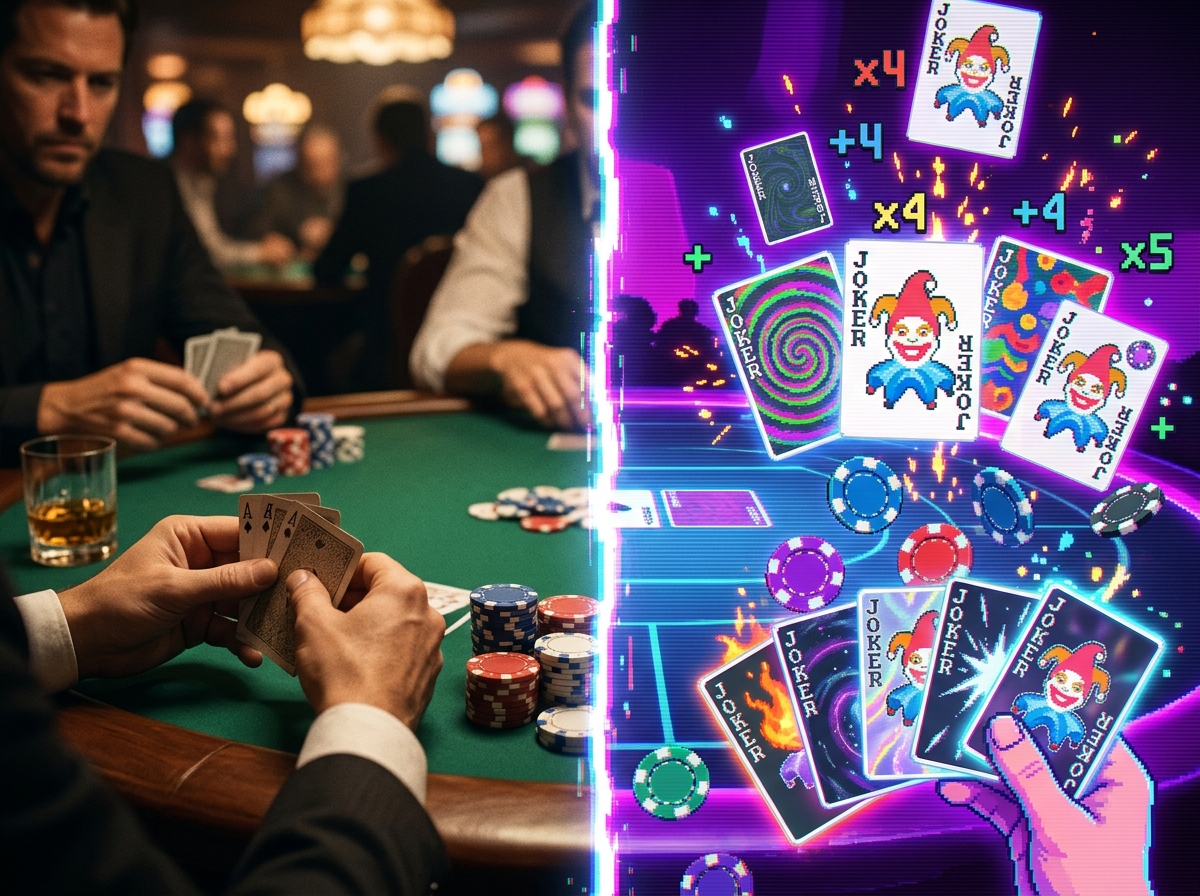
Balatro borrows the hand rankings of poker and very little else. A player works alone against a rising score target, with a deck that changes between rounds and a row of Joker cards that rewrite the scoring rules.
The game was released on February 20, 2024, by a solo developer in Saskatchewan who works under the name LocalThunk, and it earned more than $1 million in gross revenue within 8 hours of launch.
A Single Player Against a Score Target
In Texas hold’em, every decision is made against other people. Each player receives 2 private cards and shares 5 community cards with the table, and the betting takes place over 4 rounds. Much of the skill lies in judging what opponents hold and how they will respond to a raise.
Position matters too, because the player who acts last sees every other decision first, and a well-timed bluff can win a pot with the weakest hand at the table. Balatro removes all of that, since the player faces no opponent and places no bet at any point.
A run is divided into antes, and each ante contains 3 blinds, called the Small Blind, the Big Blind and the Boss Blind. In poker the blinds are forced bets that start the action on each hand. In Balatro they are score targets that rise from one blind to the next. The Small and Big Blinds can be skipped in exchange for a tag that grants a reward, but the Boss Blind has to be played.
The player draws 8 cards and has a limited number of hands and discards to reach the target, and each Boss Blind adds a special ability that interferes with the round. A run is won by clearing ante 8. An endless mode lets the run continue, and scores grow so large that the numbers overflow at ante 39.
Chips, Mult and the Scoring Formula
Every hand type in Balatro has a base value in Chips and a base value in Mult, and the score for a hand is Chips multiplied by Mult. The cards played add their own chip values. Some of the Jokers held beside the deck add Chips, some add Mult, and others multiply the Mult outright. The game launched with 150 Jokers, and the number of Joker slots is limited, so much of a run is spent deciding which ones to keep and which to sell.
Planet cards raise the level of a single hand type for the rest of the run. A player who levels up Pair again and again can make it score more than a Flush, which reverses the standard poker ranking, where a flush always beats a pair.
Anyone used to playing poker games at a table judges a hand by how often it wins at showdown. A Balatro player judges it by the points it produces under the current Jokers, and the same 5 cards can score a few dozen points early in a run and many thousands near its end.
Hands Outside the Standard Rankings
A standard 52-card deck has 1 card of each rank in each suit, so ordinary poker has a fixed list of hands from high card up to the royal flush. Five of a Kind is impossible with a single deck. Balatro lets the player rebuild the deck itself during a run.
Tarot cards can change a card’s suit or remove it from the deck, and Spectral cards have stronger effects, including copying cards. Each change lasts for the rest of the run, so a long run is a project of shaping the deck toward a small number of favored hands.
A deck reshaped in this way can produce 3 hands that standard rules have no name for. Five of a Kind needs 5 cards of one rank. A Flush House is a full house in a single suit, and a Flush Five is 5 copies of the same card. A poker deck is shuffled fresh for every hand, while a Balatro deck keeps every change the player makes until the run ends.
The Big Two Origin
LocalThunk has said that the design started from a different card game. Big Two is a climbing game that probably originated in coastal China around 1980. Each of the 4 players is dealt 13 cards, and the aim is to be the first to play every card to the table.
Twos are the highest cards in the game, which gives it its name. Its 5-card combinations resemble poker hands, with some important differences in how they rank. LocalThunk has said Balatro’s poker look was chosen because poker is familiar to far more players and easier to pick up, while the structure underneath came from Big Two.
In a Reddit question session in March 2024, LocalThunk named Luck Be a Landlord, a slot machine roguelike with no enemy and a score to chase, as the main influence on the single-player format, and said they had not played deckbuilders such as Slay the Spire before making Balatro. Development began in 2021, about 30 months before release, and the game was written in Lua using the Löve engine.
The European Age Rating Dispute
The poker imagery caused trouble with regulators in Europe. PEGI, the body that sets age ratings for games across much of the continent, first gave Balatro an 18 rating, citing prominent gambling imagery and a concern that the game could teach skills usable in real poker. Under PEGI’s rules at the time, any game that taught or glamorized simulated gambling received its highest rating automatically. In 2024 the game was briefly removed from some console storefronts over the same issue.
The publisher appealed, and in February 2025 PEGI’s Complaints Board lowered the game to a PEGI 12 rating, saying that its “mitigating fantastical elements” justified the change. PEGI then said it would review how it classifies games that depict gambling. Luck Be a Landlord received the same reduction from 18 to 12 after a separate appeal by its publisher, Fangamer. Balatro has no real-money wagering and no microtransactions.
Commercial and Critical Reception
Balatro passed 5 million copies sold in January 2025, less than a year after release, a total that does not count players who reached it through the Apple Arcade subscription. The Android and iOS versions arrived on September 26, 2024, and roughly half of those sales came after that date. In December 2024 it won 3 prizes at The Game Awards, including Best Independent Game, and in March 2025 the Game Developers Choice Awards named it Game of the Year.
Common Ground in Probability
A Balatro player who needs a heart to complete a flush counts the hearts left in the deck and judges the chance of drawing one, the same calculation a hold’em player makes when counting outs before the river. With 9 hearts among 40 unseen cards, the next card completes the flush 22.5% of the time. The overlap is narrow, since Balatro has no bets to size against those odds, but it is the kind of transferable skill PEGI cited when it first rated the game 18.